Thursday, October 25, 2012

The neverending world of the Recycled Paper

There are tons of ways of using Recycled Paper as a material. If we think about how to reuse paper when designing pieces of furniture, then we can look at existing examples such as the one designed by Artists for Humanity in Boston. This table is covered with an ecofriendly resin that protects it from the water
Table by Artists for Humanity
We have also found many designers knitting the paper such as if they were using wicker. After knitting it we need to put a final coat to protect it. The artist Movana Chen desgined a piece called Body Containers where she made clothes out of knitted paper. 


And then last, but not least, I wanted to bring Hong Kong Eureka Interior Design Office proposal for the bike shop Spread by Gum.


The space is also used as a socializing area, and therefore, the client asked it to be versatile. So Eureka designers came with a paper roll wall that can be pulled in and out depending on the needs. 5412 recycled paper tubes of 38.5 mm Ø were used to create this display.


Technical Information about this project:
Location: Tsim Sha Tsui, Hong Kong
Type: retail shop
Year: 2011
Area: 35m2
Cost: HKD180,000


Wall

Wovin Wall from 3form is a modular wall system that consists of small panels mounted on a lightweight metal grid. The removable panels are clipped in alternating directions to create the distinctive three-dimensional woven pattern
Wovin Wall is designed for modularity and longevity. The modular design ensures individual tiles or brackets can be replaced if necessary - components of the system can be rearranged, expanded upon or relocated to adapt to changing needs.
Wovin Wall is designed for disassembly. The whole system can be disassembled without a specialist or specialist tools. The components of Wovin Wall are reusable or recyclable.
This is how it works.

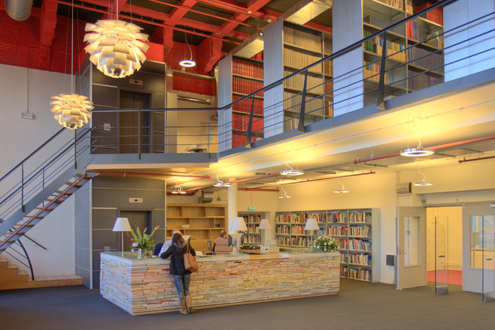
[Real] Book Counter

This counter may seem rather ordinary if we don't take a closer look at it. We are at the TU Delft Library in Netherlands, designed by the Dutch firm Mecanoo. Beside the impressive book shelves they used to build authentic "book walls", or the transparent devices to arrange the magazines, or even the grass they used to build the walk-able rooftop  they also used them to physically build the counter; quite an example of low tech design...


Check the video for a route inside the building:

Delft Media Library

DOK architects and Interior Designer AAt Vos, from Aequo BV worked together on the Delft Media Library.They have a different approach to what an ordinary library is, so they named it "Library Concept Center". And the naming is tightly related to the very neat design solutions they achieved.
The library sells itself as a "better friend than Google", they even offer a service to company managers that want to improve the working environments. They offer a high technology design  that you can check on the following video:

Don't forget to check the Heritage Board!

Sunday, October 21, 2012

Alabaster Stone Transparent Countertops

These ultra-modern, transparent hand-made countertops are, in part, characterized by natural alabaster stone, which offers the ability to alter its shape (organic stones or strips) and color (a dramatic black and a ghostly glowing white). The other distinctive quality these countertops boast is their integrated illumination, which can be used to highlight the counter’s artistic edge, but it also showcases your glass vessels in a new light. More details are available by visiting Masto Fiore.


Composition:
  • Top in Makassar wood finish color trends
  • Top with Alabaster stone manufacturing Listel white, hand made, with the particular installation LED located below the stone, which operates on 24 volts and is IP68 (high protection, even on contact with water)
  • Sink Round ø40 cm-standing transparent blown glass photoluminescent


The video above shows how beautiful the material looks with LED lit up underneath it.

Saturday, October 20, 2012

Cookie Cup


As I was sipping tea this morning, I found this on the internet: Cookie cups - using cookie as a material for tableware. Sip the coffee then eat the cup! Saves a lot of washing up! Love the idea.


This cookie cup was the creation of a Venezuelan designer named Enrique Luis Sardi which was made for Lavazza, the famous Italian coffee company. It’s so ingenius – he made it using a cookie for the outside and a special patented sugar icing on the inside. Dual purpose – it creates an insulator for the cookie and add sweetness to the coffee! 


What's more, they sell a version that is lined with chocolate, ain't that hot? This is the kinda coffee that should be served in a proper material library. :) Here's a photograph of the designer himself, even he's hot:


10 Cutting-Edge Glass Concepts

You have to see it to believe it, watch this video below. You will fall in love with the future instantly. It walks you through a day in the life of your not-too-distant future self, using glass in ways that would have sounded like pure science-fiction fantasy a few years back! I re-played it a few times and still loving it!


Here is a guided tour of the same video. The technical details are elaborated here, you won't regret spending 11 minutes 25 seconds more of your time to watch it:


I just can't wait for tomorrow to come. Have a great day!

Thursday, October 18, 2012

Heat-Activated Paint for Color-Changing Interior Designs

 What if you could change the look of your home without having to do a thing? This heat-reactive paint has a number of amazing applications (more pictured below), but one of the most impressive is the color-changing wallpaper shown step-by-step here.

 As the temperature rises within a room the flowers on the branches slowly bloom, breathing additional life and color into a given space. As night falls and cooler temperatures prevail, the colorful flower print slowly fades back to a mellow green.


 Not limited to just wallpaper, of course, this same strategy by Shi Yuan can be applied to posters or other decorative objects – and can encourage people to touch and otherwise interact with normally stationary and passive designs.


Likewise, as a reminder of each passing day, the cooling of night can erase the current date on your wall-mounted calander and show the passing of time into the next.


Hot or Cool? Color-changing Chameleon Tiles

 There is virtually no limit to what you can decorate with color-changing tiles (fromInventables). Daytime cityscapes turn into urban night scenes as the temperature in a room shifts. Notable applications include showers, floors and others surfaces likely to be exposed to temperature variations over time.


While some of these are simply colored and relatively inexpensive there are all kinds of untapped design potentials yet to be explored. Perhaps they would make a good interior design match for an exterior application of some light transmitting concrete.

Liquid Wood

 It looks like wood, feels like wood, is even made of wood – but it shifts shape and solidifies like plastic, bringing together the most powerful material assets of two of the most used materials on the planet.


Lingin (an often-discarded element of regular wood) is combined with natural resins, flax and fibers that can be injected into molds and form extremely complex, precision-shaped objects normally made of conventional, non-biodegradable petroleum-based plastics. The result has been dubbed Arboform by its German inventors, and may well revolutionize the worlds of material science and mass production.

Just like wood, it breaks down quickly and organically into eco-safe by-products like water and carbon dioxide. It is also made from a leftover part of trees that is unused during the paper-making process – over 100 million pounds of its main ingredient are created as a simple side-effect of the existing pulp industry.

What can be made of Arboform? Almost anything you can imagine from simple toys to complex gadgets, disposable cups to long-lasting automobile parts, custom-cast furniture to heavy-duty helmets – think of anything made of plastic or wood, and you will start to get the picture. In short: we are talking about the precision, flexibility and durability of plastic … with the 100% recyclable, renewable, tactile and aesthetic advantages of wood, in a single new material. Eat your heart out, see-through concrete and transparent aluminum!