Showing posts with label wall. Show all posts

Wednesday, October 31, 2012

IdeaPaint


Chalkboard wall paint has been around for a while now, but dealing with chalk dust gets old fast - the solution, of course, is to upgrade that paint just as schools have updated their own writable teaching surfaces.


Young 20-something entrepreneur John Goscha dropped out of his banking job to design and market this material "for home, work or school" that may transform walls as we know now them. It is called IdeaPaint. It is available for half the price of an actual whiteboard and works just as well or better, leaving no marks behind when you wash down your work (and, without the rest of the infrastructure, it turns out to be greener, too). Here's a video showing you how to install IdealPaint.


Here are some of the interiors where the paint were used. It is an awesome idea especially if you have kids at home who just LOVE to mess with your wall.

Tuesday, October 30, 2012

Curing Concrete: Engineered Bacteria Naturally Heals Cracks


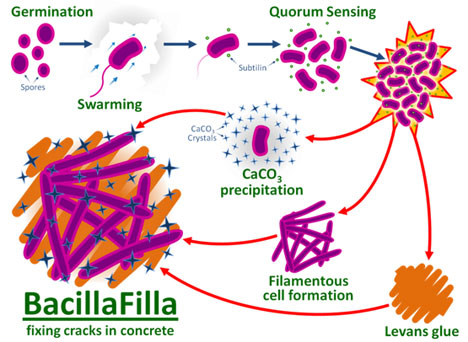
Imagine buildings that never need to be repaired, streets that heal their own cracks, and sidewalks that morph back into perfect condition after buckling and breaking. A smart bacteria might usher in all of those things and more by helping concrete seal on its own after cracking up.


Researchers at the University of Newcastle in the United Kingdom have created a genetically modified microbe that they somewhat humorously dubbed “BacillaFilla.” The microbe (derived from the bacterium Bacillus subtilis) has been tweaked to swim down into concrete cracks and secrete a mixture of bacterial glue and calcium carbonate. The secretions from the bacteria work to glue together the cracks in the concrete, making it just as strong as it was originally. Because new concrete production accounts for about five percent of all man-made CO2 emissions, finding a way to extend the life of existing structures can significantly reduce the environmental toll of construction.


The self-healing concrete would be particularly useful in places where earthquakes are common and tend to create structural damage that has historically proven very difficult to repair. Rather than razing the buildings as in the past, we could continue to use them as the damage is quickly and easily repaired. Worried about crazy concrete-secreting bacteria taking over and paving the planet? Have no fear: the bacteria would have built-in safety measures that would allow them to work their magic only in structural cracks and would cause them to self-destruct if they ventured outside of the intended target.

Another way of self-healing concrete is developed by  Delft University of Technology. They developed asphalt pavements:


The bitumen bonds can be repaired once and again, for several times, by making asphalt electrically conductive. Because asphalt concrete is not an electrically conductive material, steel wool fibers have been added. These are connected inside the asphalt concrete and create small circuits. When this new type of asphalt is heated with induction energy, the bitumen melts and that holds the road together.  
With help of this induction method, the lifetime of roads can be increased more than four times. The only necessary maintenance would be needed once in two-three years, when a machine closes all the cracks that could have appeared in that period. This not only reduces the cost of the roads by more than three times, it would also dramatically reduce the number of traffic accidents that happen due to bad road conditions and furthermore it would reduce the delays and traffic jams enormously because this maintenance is much faster compared to making a new road.

Thursday, October 25, 2012

Wall

Wovin Wall from 3form is a modular wall system that consists of small panels mounted on a lightweight metal grid. The removable panels are clipped in alternating directions to create the distinctive three-dimensional woven pattern
Wovin Wall is designed for modularity and longevity. The modular design ensures individual tiles or brackets can be replaced if necessary - components of the system can be rearranged, expanded upon or relocated to adapt to changing needs.
Wovin Wall is designed for disassembly. The whole system can be disassembled without a specialist or specialist tools. The components of Wovin Wall are reusable or recyclable.
This is how it works.

Thursday, October 18, 2012

Hot or Cool? Color-changing Chameleon Tiles

 There is virtually no limit to what you can decorate with color-changing tiles (fromInventables). Daytime cityscapes turn into urban night scenes as the temperature in a room shifts. Notable applications include showers, floors and others surfaces likely to be exposed to temperature variations over time.


While some of these are simply colored and relatively inexpensive there are all kinds of untapped design potentials yet to be explored. Perhaps they would make a good interior design match for an exterior application of some light transmitting concrete.

Wednesday, October 17, 2012

MossTiles

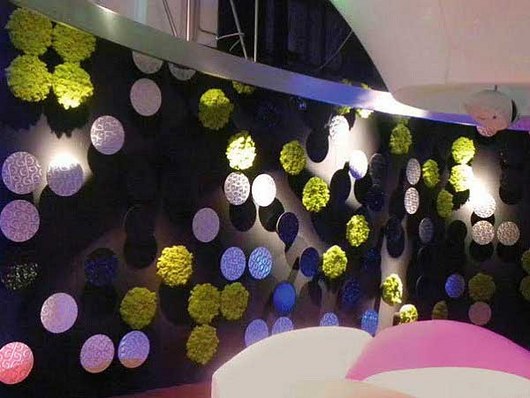
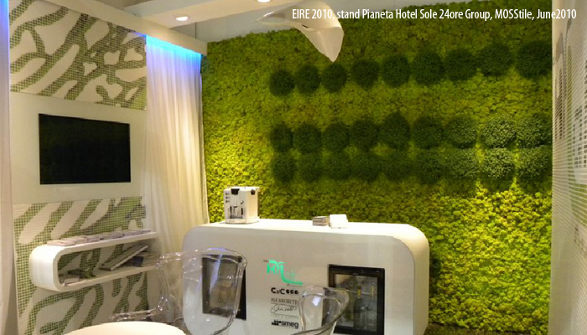
MOSStiles bring the outdoors in- without the mess!  The MOSStile is made of an ecologic resin base imbedded with natural moss for use indoors. No toxic substances are used in the making of the tile and no chemicals or fertilizers are needed to maintain them once they are installed. Maintenance is practically non-existent and no watering (except for an occasional misting) is necessary. The moss pulls all the nourishment it needs from an environment of at least 50% humidity. MOSStiles should not be placed in direct sunlight as diffuse light or even no light is best for them. And no fertilizer is required. These modular living tiles come in 12 different shades.


Just imagine the beautiful indoor vertical gardens you can create with these tiles: 


And why is there always a downside to new ideas? Because having a real plant indoor without the hassle of watering is really way too good to be true. It turns out that these are not made from moss at all, but lichens - specifically reindeer moss (Cladonia rangiferina):


This slow-growing lichen is harvested in Scandinavia, "stabilized" in a salt solution, glued onto tiles with a resin, then dyed one of twelve different colors. Hence, it is not a plant anymore. It might as well be made out of plastic. All the misting does is keeping them from drying out and crumbling to pieces. Even worse, reindeer moss is a major food source for caribou and other large ruminants. It's so slow growing that it's a threatened (and protected) species in some parts of the world.

Tuesday, October 16, 2012

Coconut Wood Composites

Traditionally, valuable tropical woods has been used to make furniture and floorings. The Coconut tree is known to have many uses, from its roots to tips (leaves), from culinary to non-culinary consumer products, industrial products and medicinal products. To many around the world, the coconut tree is considered the “Tree of Life”. Palm trees used to be cut down at the end of their coconut-bearing years and replaced with new coconut palms. Only in recent years did people started researching on the use of the palm tree after it matures.


Coconut Wood Composites quality is comparable with the tropical woods specifically in terms of durability, sturdiness, and versatility. Its hardness and effectiveness are even at par with other hardwood timber that are more popular in the market like mahogany or oak. It has minimal shrinkage, bowing, or bending properties. Dutch manufacturer Kokoshout derived the name Cocodots due to the natural patterns that the wood has.

Neptune Balls

While sitting on the beach, trying to light a campfire covered with fibrous droplets, and not having any luck, Richard Meier, an American architect, wondered why the fire would not light? Upon further investigation, he realized it was extremely difficult to put fire to these strange fibrous globs that were lying around all over the beach, and this gave him the idea that would become NeptuTherm.


Instead of using materials like aluminium and polyester as roofs and walls insulator, NeptuTherm has developed a way of using a by-product of the sea, also known as Neptune balls, for insulation. Although written in Dutch, the photographs on this webpage clearly demonstrates how to lay this amazing material between the roof panels for insulation.


Further reading:

Monday, October 15, 2012

LiTraCon (Light-Transmitting Concrete)


The world has great challenges and it needs useful solution for the challenges as like the global warming, using energy in a sustainable way and protecting the environment. We should find a good solution, for instance: use of solar energy, transparent heat insulation, passive buildings etc.. The development of the building technology in the field of building industry is a good way to eliminate the emission of green house gases, because we shall use less loam and the the industry will not need to transfer those materials.


LiTraCon provides a simple and cheap solution to the challenges. Filled with optical fibers that run from one end of a poured piece of concrete to the other, these prefabricated blocks and panels effectively transmit light from one side to the other.

 
Colors and light remain remarkably consistent from end to end, but with a natural variation from the pouring process that actually softens the effects considerably. The inventor himself, Mr. Áron Losonczi will explain in this 3 minutes video innovative ways of using the light transmitting concrete:


This Light transmitting Concrete is also very cheap and easy to make. Someone has homemade a small block and shared it on Youtube: 


Thursday, October 11, 2012

ex-AA walls

We have seen many walls made out bottles. Some of them reached a cleaner design than others. Some people even went nuts and just decided to turn his own house into a spiky shaped shelter. We could even use the bottles to start a green wall.

And here we have a video showing how we can build our own green wall: