Noise
is annoying. It interrupts communication, reduces productivity and
tires people out – in some cases, noise can cause long term psychiatric disorder. It is however unavoidable in Hong Kong, a city of hustle and bustle.
Researchers
at Empa, in cooperation with textile designer Annette Douglas and silk
weavers Weisbrod-Zürrer AG, have developed lightweight, translucent
curtain materials, which are excellent at absorbing sound.

The first acoustically optimised lightweight textile came into being on a
computer. The Empa acousticians wanted to use the characteristics of
this virtual textile in order to prepare a kind of «recipe» for material
experts, which would enable them to specifically manufacture a fabric
that could absorb sound. In addition, they first developed a
mathematical model to illustrate both the microscopic structure of the
fabric as well as its macroscopic composition. On the basis of numerous
acoustic measurements made on various samples, specifically woven by
Weisbrod-Zürrer, they were able to gradually optimise the acoustic
properties of the fabric. Annette Douglas then succeeded in translating
the new findings into weaving techniques. She chose yarns that gave the
materials the necessary characteristics in terms of flammability and
translucence and determined the weave structure, i.e. how the threads
should be woven in and out of each other. Weisbrod-Zürrer then adjusted
the sophisticated manufacturing process so that the industrially-made
curtains actually displayed the required acoustic characteristics.


The above graph is the sound absorption
measurements in Empa’s reverberation room. With a gap of 15 cm between
curtain and wall, the new developed curtain – depending on the frequency
– absorbs up to five times more sound than typical lightweight
curtains.
Because the new curtains are translucent, they can be
used in a variety of places such as offices, living rooms, restaurants,
hotel lobbies, seminar rooms and even multi-purpose auditoriums. They
are often the deciding factor in satisfying the acoustic requirements
and regulations that apply to these rooms. These curtains may be a solution to the noise in Hong Kong - what do you think?
Further reading:
Product sheets for the curtains
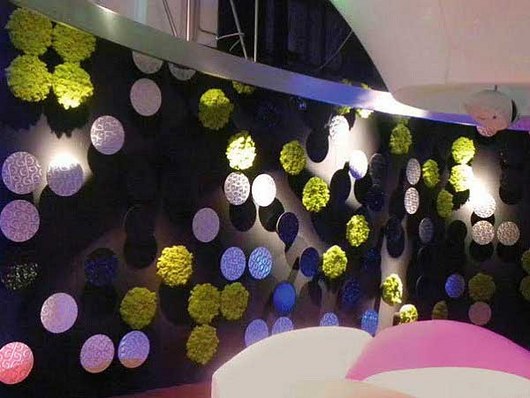
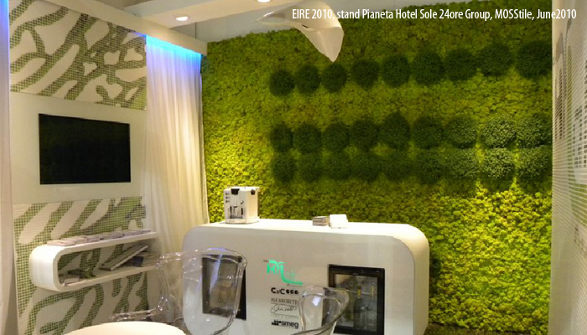
MOSStiles bring the outdoors in- without the mess! The MOSStile is made of an ecologic resin base imbedded with natural moss for use indoors.
No toxic substances are used in the making of the tile and no chemicals
or fertilizers are needed to maintain them once they are installed.
Maintenance is practically non-existent and no watering (except for an
occasional misting) is necessary. The moss pulls all the nourishment it
needs from an environment of at least 50% humidity. MOSStiles should not
be placed in direct sunlight as diffuse light or even no light is best
for them. And no fertilizer is required. These modular living tiles come in 12 different shades.
Just imagine the beautiful indoor vertical gardens you can create with these tiles:
And why is there always a downside to new ideas? Because having a real plant indoor without the hassle of watering is really way too good to be true. It turns out that these are not made from moss at all, but lichens - specifically reindeer moss (Cladonia rangiferina):
This slow-growing lichen is harvested in Scandinavia, "stabilized" in a
salt solution, glued onto tiles with a resin, then dyed one of twelve
different colors. Hence, it is not a plant anymore. It might as well be made out of plastic. All
the misting does is keeping them from drying out and crumbling to
pieces. Even worse, reindeer moss is a major food source for caribou and other
large ruminants. It's so slow growing that it's a threatened (and
protected) species in some parts of the world.