
Showing posts with label New technology. Show all posts
Showing posts with label New technology. Show all posts
Friday, April 5, 2013
Ultra Ever Dry Product

Wednesday, October 31, 2012
Dance Floor Power!
Club Surya opened its doors in London in 2008 making it Britain’s first
eco friendly nightclub. The club itself is built of recycled materials,
but the dance floor is the best piece. Using piezoelectricity technology, a way of converting the kinetic energy of the dance into
electricity, it produces enough electricity to power sixty percent of
the entire club.

 The brainchild of 39-year-old property developer Andrew Charalambous,
aka Dr. Earth, Surya has its own wind turbine and solar energy system,
with the plan to donate any surplus electricity to local residents.
The brainchild of 39-year-old property developer Andrew Charalambous,
aka Dr. Earth, Surya has its own wind turbine and solar energy system,
with the plan to donate any surplus electricity to local residents.
When clubbers need a rest from strutting their stuff on the dance floor they can relieve themselves at the latest air flush, waterless urinals and low flush toilets as well as taking the opportunity to freshen up with the club's automatic taps.
If Princes Harry and William and their aristocratic friends, who are frequently spotted at hot London nightclubs such as Boujis or Mahiki, want to attend Surya they will have to sign a pledge to work towards curbing climate change like all patrons attending the club in north London.
"Unless we stop preaching to people and use an inclusive philosophy we're never going to create the revolution to combat climate change," Charalambous told Reuters, explaining why he has invested one million pounds in the club.
"It's also about creating avenues of thought. Imagine what you could achieve if big corporations adopted this kind of initiative."
The technology used in this flooring can be used in just about anything. There’s even plans to fit it into clothing so people can generate electricity by moving which will be able to power mobile electrical devices.
When clubbers need a rest from strutting their stuff on the dance floor they can relieve themselves at the latest air flush, waterless urinals and low flush toilets as well as taking the opportunity to freshen up with the club's automatic taps.
If Princes Harry and William and their aristocratic friends, who are frequently spotted at hot London nightclubs such as Boujis or Mahiki, want to attend Surya they will have to sign a pledge to work towards curbing climate change like all patrons attending the club in north London.
"Unless we stop preaching to people and use an inclusive philosophy we're never going to create the revolution to combat climate change," Charalambous told Reuters, explaining why he has invested one million pounds in the club.
"It's also about creating avenues of thought. Imagine what you could achieve if big corporations adopted this kind of initiative."
The technology used in this flooring can be used in just about anything. There’s even plans to fit it into clothing so people can generate electricity by moving which will be able to power mobile electrical devices.

Transition Metal Switchable Mirror


The switchable-mirrors technology was developed by Tom Richardson and Jonathan Slack of Berkeley Lab's Environmental Energy Technologies Division. By using transition metals rather than the rare earth metals used in the first metal-hydride switchable mirrors, Richardson and Slack were able to lower the cost and simplify the manufacturing process. Energy performance is improved as well, because the new windows can reflect or transmit both visible and infrared light. Besides windows for offices and homes, possible applications include automobile sunroofs, signs and displays, aircraft windows, and spacecraft.
Vacuum Floor Mat Cleans Your Shoes
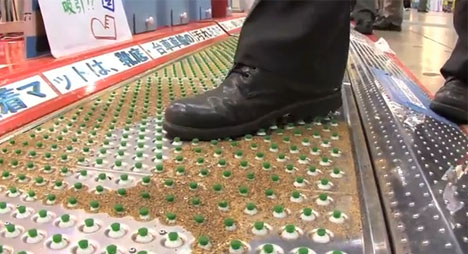

Viz Gizmodo: “The mat was developed by Paionia Furyokuki and its surface is perforated with valves that are only opened as they’re stepped on. So as someone walks across the mat, it activates what are essentially a series of little vacuums that suck the dirt and debris off the sole of the shoe, and then into an external unit where it can be later disposed of”

Now, to be fair, these are probably a great idea for high-traffic industrial spaces that are hard to keep clean, or for someone with a passion, say, for fixing and cleaning cars in their garage. And who knows: maybe with time the technology will become cheaper, and these will replace everyday mud mats in the modern home.
Tuesday, October 30, 2012
Curing Concrete: Engineered Bacteria Naturally Heals Cracks
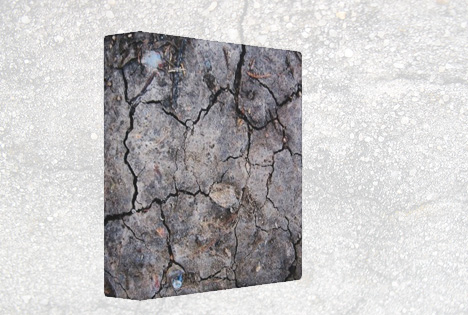
Imagine buildings that never need to be repaired, streets that heal their own cracks, and sidewalks that morph back into perfect condition after buckling and breaking. A smart bacteria might usher in all of those things and more by helping concrete seal on its own after cracking up.
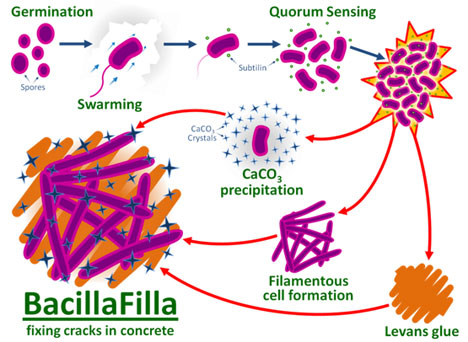
The self-healing concrete would be particularly useful in places where earthquakes are common and tend to create structural damage that has historically proven very difficult to repair. Rather than razing the buildings as in the past, we could continue to use them as the damage is quickly and easily repaired. Worried about crazy concrete-secreting bacteria taking over and paving the planet? Have no fear: the bacteria would have built-in safety measures that would allow them to work their magic only in structural cracks and would cause them to self-destruct if they ventured outside of the intended target.
Another way of self-healing concrete is developed by Delft University of Technology. They developed asphalt pavements:
The bitumen bonds can be repaired once and again, for several times, by making asphalt electrically conductive. Because asphalt concrete is not an electrically conductive material, steel wool fibers have been added. These are connected inside the asphalt concrete and create small circuits. When this new type of asphalt is heated with induction energy, the bitumen melts and that holds the road together. |
Wednesday, October 17, 2012
Luminoso Light Emitting Wood Panels
Luminoso is a wood composite panel composed of high-grade fiber
optics embedded between thin wood layers and then firmly glued together.
The Luminoso light transmitting panels have been produced by Litwork GmbH since 2008. All of the common wood types can be utilized such as
black cherry, oak, teak, Wenge, etc. The panel sizes are: 12” x 20”, 11”
x 20” and 39” x 118”.


This is the company promotional footage:
Check this out as to how the panel looks with a galloping horse behind it.


This is the company promotional footage:
Check this out as to how the panel looks with a galloping horse behind it.
Curtains that quench noise
Noise
is annoying. It interrupts communication, reduces productivity and
tires people out – in some cases, noise can cause long term psychiatric disorder. It is however unavoidable in Hong Kong, a city of hustle and bustle.
Researchers at Empa, in cooperation with textile designer Annette Douglas and silk weavers Weisbrod-Zürrer AG, have developed lightweight, translucent curtain materials, which are excellent at absorbing sound.

The first acoustically optimised lightweight textile came into being on a computer. The Empa acousticians wanted to use the characteristics of this virtual textile in order to prepare a kind of «recipe» for material experts, which would enable them to specifically manufacture a fabric that could absorb sound. In addition, they first developed a mathematical model to illustrate both the microscopic structure of the fabric as well as its macroscopic composition. On the basis of numerous acoustic measurements made on various samples, specifically woven by Weisbrod-Zürrer, they were able to gradually optimise the acoustic properties of the fabric. Annette Douglas then succeeded in translating the new findings into weaving techniques. She chose yarns that gave the materials the necessary characteristics in terms of flammability and translucence and determined the weave structure, i.e. how the threads should be woven in and out of each other. Weisbrod-Zürrer then adjusted the sophisticated manufacturing process so that the industrially-made curtains actually displayed the required acoustic characteristics.

 The above graph is the sound absorption
measurements in Empa’s reverberation room. With a gap of 15 cm between
curtain and wall, the new developed curtain – depending on the frequency
– absorbs up to five times more sound than typical lightweight
curtains.
The above graph is the sound absorption
measurements in Empa’s reverberation room. With a gap of 15 cm between
curtain and wall, the new developed curtain – depending on the frequency
– absorbs up to five times more sound than typical lightweight
curtains.
Because the new curtains are translucent, they can be used in a variety of places such as offices, living rooms, restaurants, hotel lobbies, seminar rooms and even multi-purpose auditoriums. They are often the deciding factor in satisfying the acoustic requirements and regulations that apply to these rooms. These curtains may be a solution to the noise in Hong Kong - what do you think?
Further reading:
Product sheets for the curtains
Researchers at Empa, in cooperation with textile designer Annette Douglas and silk weavers Weisbrod-Zürrer AG, have developed lightweight, translucent curtain materials, which are excellent at absorbing sound.

The first acoustically optimised lightweight textile came into being on a computer. The Empa acousticians wanted to use the characteristics of this virtual textile in order to prepare a kind of «recipe» for material experts, which would enable them to specifically manufacture a fabric that could absorb sound. In addition, they first developed a mathematical model to illustrate both the microscopic structure of the fabric as well as its macroscopic composition. On the basis of numerous acoustic measurements made on various samples, specifically woven by Weisbrod-Zürrer, they were able to gradually optimise the acoustic properties of the fabric. Annette Douglas then succeeded in translating the new findings into weaving techniques. She chose yarns that gave the materials the necessary characteristics in terms of flammability and translucence and determined the weave structure, i.e. how the threads should be woven in and out of each other. Weisbrod-Zürrer then adjusted the sophisticated manufacturing process so that the industrially-made curtains actually displayed the required acoustic characteristics.

Because the new curtains are translucent, they can be used in a variety of places such as offices, living rooms, restaurants, hotel lobbies, seminar rooms and even multi-purpose auditoriums. They are often the deciding factor in satisfying the acoustic requirements and regulations that apply to these rooms. These curtains may be a solution to the noise in Hong Kong - what do you think?
Further reading:
Product sheets for the curtains
Subscribe to:
Posts (Atom)