Most people pay attention to the part of the mushroom we see (and sometimes even eat) that grows above the ground – but what about the latticework of tendrils that intertwine inside the dirt from which they grow?
As it turns out, this malleable network can, per Philip Ross, “be used to form a super-strong, water-, mold- and fire-resistant building material. The dried mycelium can be grown and formed into just about any shape, and it has a remarkable consistency that makes it stronger, pound for pound, than concrete.”
Stools and chairs are just the start – stone-like arches and eventually whole buildings may be yet to come. Like bamboo, the speed of growth and workability of the material make it a great candidate for locally-grown architecture, particularly in fungi-friendly climates. The strength of concrete, but easier to create and lightweight to boot – we have not seen the last of mushroom-based building technologies.
Luminoso is a wood composite panel composed of high-grade fiber
optics embedded between thin wood layers and then firmly glued together.
The Luminoso light transmitting panels have been produced by Litwork GmbH since 2008. All of the common wood types can be utilized such as
black cherry, oak, teak, Wenge, etc. The panel sizes are: 12” x 20”, 11”
x 20” and 39” x 118”.
This is the company promotional footage:
Check this out as to how the panel looks with a galloping horse behind it.
Noise
is annoying. It interrupts communication, reduces productivity and
tires people out – in some cases, noise can cause long term psychiatric disorder. It is however unavoidable in Hong Kong, a city of hustle and bustle.
Researchers
at Empa, in cooperation with textile designer Annette Douglas and silk
weavers Weisbrod-Zürrer AG, have developed lightweight, translucent
curtain materials, which are excellent at absorbing sound.
The first acoustically optimised lightweight textile came into being on a
computer. The Empa acousticians wanted to use the characteristics of
this virtual textile in order to prepare a kind of «recipe» for material
experts, which would enable them to specifically manufacture a fabric
that could absorb sound. In addition, they first developed a
mathematical model to illustrate both the microscopic structure of the
fabric as well as its macroscopic composition. On the basis of numerous
acoustic measurements made on various samples, specifically woven by
Weisbrod-Zürrer, they were able to gradually optimise the acoustic
properties of the fabric. Annette Douglas then succeeded in translating
the new findings into weaving techniques. She chose yarns that gave the
materials the necessary characteristics in terms of flammability and
translucence and determined the weave structure, i.e. how the threads
should be woven in and out of each other. Weisbrod-Zürrer then adjusted
the sophisticated manufacturing process so that the industrially-made
curtains actually displayed the required acoustic characteristics.
The above graph is the sound absorption
measurements in Empa’s reverberation room. With a gap of 15 cm between
curtain and wall, the new developed curtain – depending on the frequency
– absorbs up to five times more sound than typical lightweight
curtains.
Because the new curtains are translucent, they can be
used in a variety of places such as offices, living rooms, restaurants,
hotel lobbies, seminar rooms and even multi-purpose auditoriums. They
are often the deciding factor in satisfying the acoustic requirements
and regulations that apply to these rooms. These curtains may be a solution to the noise in Hong Kong - what do you think?
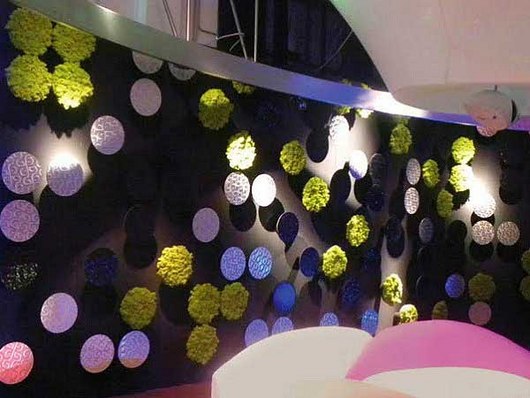
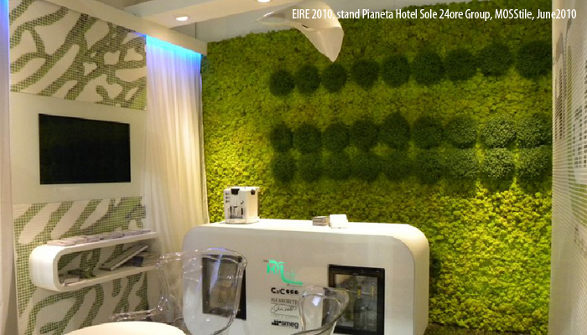
MOSStiles bring the outdoors in- without the mess! The MOSStile is made of an ecologic resin base imbedded with natural moss for use indoors.
No toxic substances are used in the making of the tile and no chemicals
or fertilizers are needed to maintain them once they are installed.
Maintenance is practically non-existent and no watering (except for an
occasional misting) is necessary. The moss pulls all the nourishment it
needs from an environment of at least 50% humidity. MOSStiles should not
be placed in direct sunlight as diffuse light or even no light is best
for them. And no fertilizer is required. These modular living tiles come in 12 different shades.
Just imagine the beautiful indoor vertical gardens you can create with these tiles:
And why is there always a downside to new ideas? Because having a real plant indoor without the hassle of watering is really way too good to be true. It turns out that these are not made from moss at all, but lichens - specifically reindeer moss (Cladonia rangiferina):
This slow-growing lichen is harvested in Scandinavia, "stabilized" in a
salt solution, glued onto tiles with a resin, then dyed one of twelve
different colors. Hence, it is not a plant anymore. It might as well be made out of plastic. All
the misting does is keeping them from drying out and crumbling to
pieces. Even worse, reindeer moss is a major food source for caribou and other
large ruminants. It's so slow growing that it's a threatened (and
protected) species in some parts of the world.
We all know gecko's fingers stick to our walls. Since about 2000, scientists have cracked the secret of how
geckos are able to perform extraordinary climbing antics. The researchers confirmed that tiny intermolecular forces - so called van der Waals forces - were produced by literally billions of tiny
hair-like structures, or spatulae, on each gecko toe.
These forces, which arise when unbalanced electrical charges around
molecules attract one another, allow the animal to scurry up walls and
even hang upside down on polished glass.
Now, the researchers have managed to create an artificial version of the spatulae. A team from the University of Massachusetts
to invent Geckskin, an extremely powerful reusable adhesive that leaves
behind no sticky residue. The device is 16 inches square and can
support up to 700 pounds on a smooth surface such as glass or a wall.
In the following video, the team would explain how it works and its amazing adhesive abilities.
Well, thank you little gecko for inspiring the new technology!
With the pollution level in Hong Kong, it would be wonderful if there are any products which can reduce the formation of smog.
And guess what BoralPure™ SMOG-EATING Tile is the answer! "Smog-eating tiles" can oxidize the smog-forming nitrogen oxides released in the air. The tiles are coated with titanium dioxide, a photocalyst that can
oxidize harmful air pollutants emitted in the burning of fossil fuels.
When exposed to natural light, the titanium dioxide breaks down nitrogen
oxides in the air and turns them into harmless calcium nitrate.
Over one year, a 2000 sq ft smog eating concrete tile roof can destroy
the same amount of Nitrogen Oxides as a car produces from being driven 17,380km.
Calcium nitrate washes off your roof with normal precipitation and is a regular garden fertilizer.
The tiles are made purely from minerals with an inorganic surface that withstands weather conditions. The tile surface does not promote organic growth such as moss and
algae. Airborne pollutants are destroyed by the effect of sunlight on
the catalyst and are rinsed off by rainfall. Additionally, because of
the special pore structure, the concrete tiles dry out in half the time
it takes ordinary tiles. These amazing tiles may save the future of Hong Kong!
Traditionally, valuable tropical woods has been used to make furniture
and floorings. The Coconut tree is known to have many uses, from its roots to tips (leaves), from culinary to non-culinary consumer products, industrial products and medicinal products. To many around the world, the coconut tree is considered the “Tree of Life”. Palm trees used to be cut down at the end of their coconut-bearing years and replaced with new coconut palms. Only in recent years did people started researching on the use of the palm tree after it matures.
Coconut Wood Composites quality is comparable with the tropical woods specifically in terms of durability, sturdiness, and versatility. Its hardness and effectiveness are even at par with other hardwood timber that are more popular in the market like mahogany or oak. It has minimal shrinkage, bowing, or bending properties. Dutch manufacturer Kokoshout derived the name Cocodots due to the natural patterns that the wood has.
While sitting on the beach, trying to light a campfire covered with fibrous droplets, and not having any luck, Richard Meier, an American architect, wondered why the fire would not light? Upon further investigation, he realized it was extremely difficult to put fire to these strange fibrous globs that were lying around all over the beach, and this gave him the idea that would become NeptuTherm.
Instead of using materials like aluminium and polyester as roofs and walls insulator, NeptuTherm has developed a way of using a by-product of the sea, also known as Neptune balls, for insulation. Although written in Dutch, the photographs on this webpage clearly demonstrates how to lay this amazing material between the roof panels for insulation.
The world has great challenges and it needs useful solution for the
challenges as like the global warming, using energy in a
sustainable way and protecting the environment. We should find a good
solution, for instance: use of solar energy, transparent heat
insulation, passive buildings etc.. The development of the building
technology in the field of building industry is
a good way to eliminate the emission of green house gases, because we
shall use less loam and the the industry will not need to transfer those
materials.
LiTraCon provides a simple and cheap solution to the challenges. Filled with optical fibers that run from one end of a poured piece of
concrete to the other, these prefabricated blocks and panels effectively
transmit light from one side to the other.
Colors and light remain
remarkably consistent from end to end, but with a natural variation from
the pouring process that actually softens the effects considerably. The inventor himself, Mr. Áron Losonczi will explain in this 3 minutes video innovative ways of using the light transmitting concrete:
This Light transmitting Concrete is also very cheap and easy to make. Someone has homemade a small block and shared it on Youtube:
Trees to wood to paper - paper to wood to useful objects!
What can be more clever than recycling by reversing the line of production? Well, maybe not turning the paper into a tree, but at least to something useful! Yes, we all know it is bad to cut down trees, we know we can read the newspaper online nowadays, but personally I still prefer reading a good old newspaper in paper format. Designer Meike Meijer and DesignLabel ViJ5take newspapers back to their origins by turning them into a wood-like building material called NewspaperWood. Furniture, decorative objects and even jewelry look spectacular when made with the artificial wood.Here is a short interview with the team on their inspiration.